Tag

Minimalist

Browsing

Dopamine Fast

Do you find yourself scrolling through TikTok while the TV is on? Do you feel an urgent need to check your phone the second you hit a “boring” moment in line at the grocery store?

If so, your brain’s reward system might be “redlined.”

At LogOffly, we’re seeing a massive rise in Digital Overstimulation. Our world is designed to flood our brains with dopamine—the “seeking” chemical—through likes, pings, infinite scrolls, and high-speed entertainment. The result? We lose our ability to enjoy simple, slow pleasures.

open book beside white ceramic teacup on saucer

What is Dopamine Fasting (and what is it NOT)?

First, let’s clear up a myth: You cannot literally “fast” from dopamine. It’s a neurotransmitter your body needs to function.

Dopamine Fasting is actually about stimulus control. It’s a period of time where you intentionally avoid “high-arousal” triggers—like social media, gaming, and junk food—to allow your brain’s receptors to become more sensitive again. It’s a “factory reset” for your focus.

The Signs You Need a Reset

The Reward Loop: You feel anxious when you aren’t consuming content.

The “Numb” Effect: Things that used to be fun (like reading a book or going for a walk) now feel incredibly boring.

Constant Distraction: You can’t focus on a single task for more than five minutes without a “hit” of something else.

The Essential Tool for a Successful Fast

The hardest part of a dopamine reset isn’t the lack of stimulation; it’s the impulse to reach for your phone during the “quiet” moments. To succeed, you need to replace the digital fidget with a physical, calming activity.

Our Top Recommendation: The Shashibo Shape-Shifting Magnetic Fidget Box

When you remove the high-dopamine hits of a smartphone, your hands will feel “restless.” The Shashibo Box is the perfect tool for a dopamine fast. It is an award-winning, magnetic puzzle box that transforms into over 70 shapes.

  • Why it works: It provides a “low-arousal” tactile experience. Unlike a screen, it doesn’t shout for your attention. It encourages “Deep Play” and spatial reasoning, helping your brain transition from consuming to creating.
  • The Result: It keeps your hands busy during “gap moments” (like waiting for coffee or sitting on the train) without triggering a dopamine spike.

Note: Supporting LogOffly via our links helps us stay dedicated to science-backed digital wellness!

How to Do a Realistic Dopamine Fast

You don’t need to sit in a dark room for 24 hours. Try this LogOffly “Tiered” Approach:

  1. Level 1: The Daily “Golden Hour”: No screens for the first hour after you wake up and the last hour before you sleep.
  2. Level 2: The “Sabbath” (24 Hours): Once a week, go 24 hours without social media, YouTube, or Netflix. Focus on reading, cooking, and walking.
  3. Level 3: The Radical Reset (Weekend): A full 48-hour “Analog Only” weekend. No internet, no processed sugar, no gaming.

What to Expect

Initially, you will feel boredom—and that’s a good thing! Boredom is the “cleansing agent” of the mind. On the other side of that boredom is a newfound ability to focus, a lower level of anxiety, and a deeper appreciation for the real world.

The Question

The Question: What is the one “digital habit” you feel most addicted to? Could you survive 24 hours without it this weekend?

Digital Minimalism

In the world of digital wellness, people often think there are only two options: be a “screen slave” who checks their phone 200 times a day, or become a “digital hermit” who moves to a cabin in the woods and throws their laptop in a lake.

At LogOffly, we believe there is a much more powerful third way: Digital Minimalism.

The goal isn’t to quit technology; it’s to reclaim your intentionality. It’s the difference between being a passenger on a runaway train and being the conductor.

a laptop computer sitting on top of a white table

The Difference: Abstinence vs. Minimalism

Digital Abstinence is about avoidance. It’s a “just say no” approach. While a temporary “digital detox” is great for a reset, total abstinence is rarely sustainable in a world where we need tech for work, banking, and travel.

Digital Minimalism is about optimization. It’s a philosophy of technology use in which you focus your online time on a small number of carefully selected and optimized activities that strongly support the things you value, and then happily miss out on everything else.

Why “Intentionality” is the New Luxury

In an attention economy, the most valuable thing you own is your focus. Technology is an incredible tool, but it makes for a terrible master.

  • The Tool Mindset: A minimalist uses a smartphone like a hammer—you pick it up when you have a nail to hit, and you put it down when you’re done.
  • The Toy Mindset: A “maximalist” uses a smartphone like a slot machine—picking it up just to see “what’s happening,” letting the algorithm dictate their afternoon.

The Minimalist’s Anchor: Building Offline Habits

To succeed at digital minimalism, you need “analog anchors”—physical tools that provide a superior experience to their digital counterparts. When the analog version is more satisfying, you won’t want to reach for your phone.

Our Top Recommendation: The Loftie Alarm Clock

The biggest barrier to digital intentionality is the “Smartphone Alarm.” If your phone is the last thing you touch at night and the first thing you touch in the morning, you’ve already lost the battle for your attention.

The Loftie Alarm Clock is designed specifically to help you banish your smartphone from the bedroom.

  • Why it works: It’s a beautiful, high-tech device that isn’t a smartphone. It features high-quality soundscapes, guided meditations, and a “two-stage” alarm that wakes you up gently.
  • The Result: You can leave your phone in the kitchen. You start your day with intention and breath, rather than headlines and emails. It’s the ultimate investment in a minimalist lifestyle.

Note: Supporting LogOffly via our affiliate links helps us continue to provide deep dives into the science of focus!

How to Move Toward Intentionality

If you’re ready to move from “accidental” use to “minimalist” use, try these three steps:

  1. Define the “Why”: Before you open an app, ask: “What is my goal right now?” If the answer is “I’m bored,” find a physical alternative.
  2. The “One-App-One-Task” Rule: Stop multitasking. If you’re on a Zoom call, close all other tabs. If you’re texting a friend, don’t also have the TV on. Give your full attention to one digital task at a time.
  3. Choose Quality Over Frictionless: It’s easier to scroll Netflix than to read a book, but the book leaves you feeling more restored. Choose the “high-quality” activity even if it takes more effort to start.

Digital minimalism isn’t about doing less; it’s about making room for more of what actually matters.

The Question

The Question: If you removed every app from your phone that didn’t provide you with genuine value or utility, what would be left on your home screen?


Notification Fast

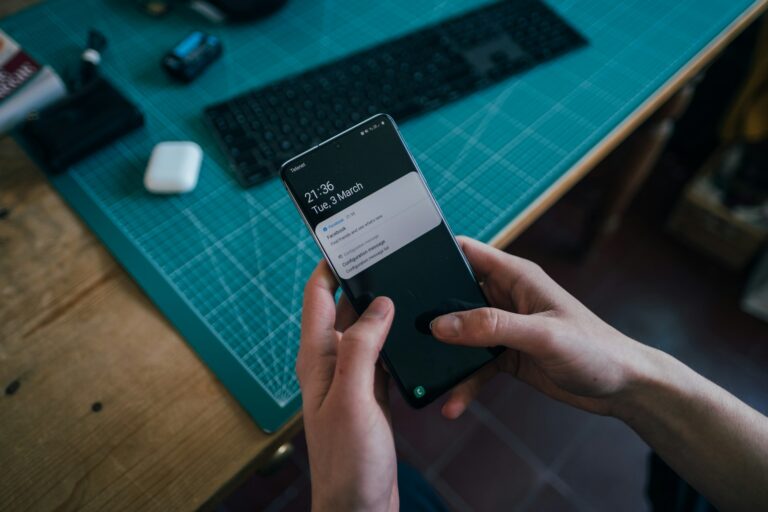
We’ve become Pavlov’s dogs. Every time our pocket buzzes with a “like,” a news alert, or a promotional email, we reflexively reach out. We think we’re staying “informed,” but in reality, we’re suffering from Continuous Partial Attention.

At LogOffly, we believe the fastest way to lower your cortisol and regain your focus is a radical intervention. We call it the 30-Day Notification Fast.

The rules are simple: For the next month, you turn off every single push notification on your phone, with only two exceptions: Phone Calls and Text Messages (SMS/WhatsApp) from actual humans.

a woman holding a cell phone in her hand

Why 30 Days?

It takes roughly 21 to 66 days to prune old neural pathways and build new ones.

Week 1 (The Withdrawal): You will feel “phantom vibrations.” You’ll check your phone constantly, fearing you’ve missed something.

Week 2 (The Calm): The phantom pings fade. You start to notice the world around you more. Your “input anxiety” begins to drop.

Week 3 & 4 (The Mastery): You realize that 99% of what you thought was “urgent” was actually just “noise.” You start opening apps when you want to, not when they command you to.

What Stays and What Goes?

❌ THE NOISE (Turn OFF): Social media likes/comments, News alerts, Email pings, Game invites, Shopping “deals,” and YouTube “New Video” alerts.

✅ THE ESSENTIALS (Stay ON): Direct phone calls and direct messages from friends/family/colleagues.

The Secret Weapon for a Successful Fast

The hardest part of a Notification Fast is the temptation to “just check” the apps manually. If you find yourself mindlessly opening Instagram just because you haven’t seen a notification in an hour, you need to create a physical barrier.

Our Top Recommendation: The kSafe Mini (Kitchen Safe) Locking Container

If you want to ensure your “Fast” actually sticks—especially during “Deep Work” hours or family time—the kSafe Mini is a life-saver. It’s a high-quality, BPA-free container with a giant timer on the lid. You put your phone in, rotate the dial, and lock it away for anywhere from 1 minute to 10 days.

  • Why it works: It removes the need for willpower. When your phone is physically inaccessible, the “urge to check” disappears within minutes, allowing your brain to enter a state of deep relaxation or focus.
  • The Result: You’ll find yourself finishing books, having deeper conversations, and finally sleeping without that “blue light” temptation.

Note: Supporting LogOffly through our affiliate links keeps us ad-free and focused on your digital freedom!

How to Prepare for the Fast

Before you flip the switches, do these three things:

  1. Tell Your Inner Circle: Let your close friends and family know: “I’m doing a 30-day digital fast. If you need me urgently, call me. Otherwise, I’ll reply when I check my messages later today.”
  2. Clean Your Home Screen: Move your “temptation apps” (Social media, News) off your first screen and into folders.
  3. Set Your “Check-In” Times: Decide on two times a day (e.g., 12:00 PM and 5:00 PM) when you will manually open your apps to see what you missed.

Are You Ready?

The world won’t end if you don’t know that someone liked your photo within three seconds. But your peace of mind might just begin.

The Question

The Question: Which specific app on your phone is the “loudest” (sends the most notifications)? How would your day change if that app suddenly went silent?


Digital Minimalism

We spend hours every year tidying our physical homes. We organize our closets, donate old clothes, and clear our desks to find mental clarity. But what about the “home” we carry in our pockets?

Most of us are living in a state of digital clutter. Our phones are packed with apps we don’t use, notifications we don’t need, and icons that trigger subconscious stress the moment we unlock our screens.

If you want to reclaim your focus, it’s time to apply the Marie Kondo method to your digital life. It’s time for the LogOffly Digital Minimalism Challenge.

person writing on a book

Step 1: The Great App Audit

The first step isn’t about deleting everything; it’s about evaluation. Go through every single app on your phone and ask yourself one simple question:

“Does this app serve a vital purpose or bring me genuine joy?”

If the answer is “It just kills time,” “I might need it one day,” or “It makes me feel anxious,” it’s a candidate for deletion. Be ruthless. If you haven’t opened it in the last 30 days, you likely don’t need it.

Step 2: Identify the Energy Vampires

Not all apps are created equal. Some are tools (Maps, Banking, Utilities), while others are vampires (infinite-scroll Social Media, News alerts, addictive Games).

  • Tools work for you.
  • Vampires make you work for them.

Try moving your “Energy Vampires” off your home screen and into folders, or better yet, delete the app and access them only via your mobile browser. This small friction creates a “speed bump” that stops mindless scrolling.

Step 3: Curate Your “Quiet” Home Screen

A minimalist home screen should be a place of calm. Aim for a layout that only shows your 4 to 8 most essential, “joy-sparking” apps.

Disable badges: Those little red circles are designed to trigger a stress response. Turn them off for everything except perhaps your phone and calendar.

Use a minimalist wallpaper: A solid color or a calm landscape.

The Result: Digital Intentionality

By decluttering your phone, you are clearing the path to your own attention. When you pick up your device, you should be doing so with intent, not out of a habit of escaping boredom.

Your phone should be a tool that enhances your life, not a cluttered closet that weighs you down.

The Question

The Question: If you had to delete every app on your phone except for three, which three would you keep—and why do those spark the most joy for you?


Logged Off?

Do you remember the last time you sat on a train and simply stared out the window? Or stood in line at a grocery store, observing the people around you, lost in your own thoughts? Not too long ago, these moments of “nothingness” were a natural part of our day. Today, they have almost entirely vanished. The second a moment of stillness creeps in, we reach for our pockets. We check a notification, scroll through a feed, or play a quick game. We have effectively declared war on boredom.

But in winning that war, we might be losing something far more precious: our creativity.

person holding book with sketch

The “Default Mode” of the Brain

Science tells us that when we are bored, our brains aren’t actually “off.” In fact, they enter what researchers call the Default Mode Network (DMN).

When you stop focusing on external stimuli (like your screen), your brain begins to look inward. It starts making “incidental connections”—linking a memory from three years ago to a problem you’re trying to solve today. This is the birthplace of the “Aha!” moment. By constantly filling every gap with digital noise, we are denying our brains the space to do this essential work.

The Challenge: Reclaiming the Gap

Creativity requires a certain amount of “white space.” To be creative is to connect things that haven’t been connected before, but you cannot connect the dots if you are too busy looking for new dots to collect.

If we want to be more than just passive consumers of content, we have to learn to be bored again. We have to let the silence sit there without trying to “fix” it with a smartphone.

The Question

The Question: When was the last time you were truly bored? Not “waiting-for-a-text” bored, but staring-at-the-wall, mind-wandering, no-device-in-sight bored?

If you can’t remember, today might be the perfect day to put your phone down, look out the window, and see where your mind takes you.